FOLLOWS ARE MANY EXCITING EXHIBITS AND ART EVENTS. CONTACT EACH VENUE DIRECTLY FOR CONFIRMATION AND TICKETING.
CURRENT EVENTS AT VARIOUS MUSEUMS
SAT. & SUNDAYS (12-4:30pm): MAKE WITH MAAM: MassArt Art Museum invites anyone to drop in every weekend for FREE hands-on fun! During Make with MAAM, find inspiration in their current exhibitions and explore connections between your creativity and the art on view. Design your own watercolor world, build a mini mythical creature, and create a unique print in the Studio! Invite family and friends or connect with other members of the MAAM community! All ages welcome.
################################################
PEABODY ESSEX MUSEUM For complete museum and exhibition details visit www.pem.org
EnChroma glasses are now available to color-blind visitors to see artworks in vibrant hues!
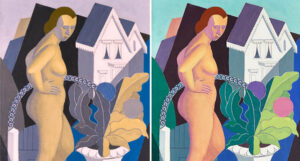 .Ambrose Webster, Webster House, Provincetown (detail), 1931. Oil on canvas. The Sheila W. and Samuel M. Robbins Collection. 2015.44.66. Peabody Essex Museum. Photo by Kathy Tarantola/PEM.
NOW OPEN: PEM’s EAST INDIA MARINE HALL
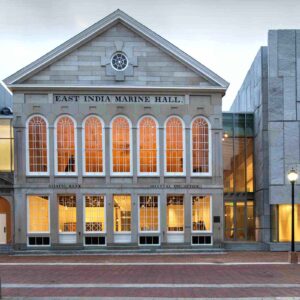 The Peabody Essex Museum (PEM). in historic Salem Massachusetts, is he oldest continuously operating museum in the United States. It is celebrating the 200th anniversary of the museum’s first permanent gathering and exhibition space, the East India Marine Hall / It was designed by architect Thomas Waldron Sumner in the Greek Revival style and ultimately built in 1825 by the East India Marine Society. The East India Marine Hall is the heart of the museum and is now recognized to be a National Historic Landmark.
 Over the last 200 years, East India Marine Hall has been visited by people from all walks of life in the United States and across the globe — from American presidents to foreign travelers to the farmer in the town next door,” said Dan Finamore, PEM’s Deputy Chief Curator and The Russell W. Knight Curator of Maritime Art and History. “From its inception, this space and these objects, collected by the museum’s seafaring founders, have elicited curiosity and wonder and transported visitors to places around the world.” The hall is distinguished by its tall arched windows and the 19th-century ship figureheads that line its walls. It was built using local Cape Ann granite and served as the society’s exhibition hall, as well as the site for long and lavish dinners where members toasted their adventures and shared their stories of ocean voyages beyond the Cape of Good Hope and Cape Horn..“Over the last 200 years, East India Marine Hall has been visited by people from all walks of life in the United States and across the globe — from American presidents to foreign travelers to the farmer in the town next door,” said Dan Finamore, PEM’s Deputy Chief Curator and The Russell W. Knight Curator of Maritime Art and History. “From its inception, this space and these objects, collected by the museum’s seafaring founders, have elicited curiosity and wonder and transported visitors to places around the world.”
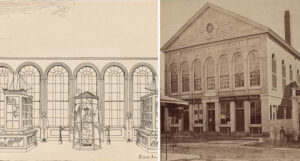
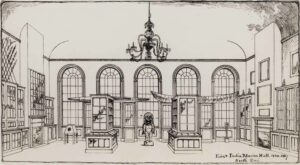 East India Marine Hall as it was arranged prior to 1867. South end, Sketch by J.H. Emmerton 1824-1867. Includes Ku background. Peabody Essex Museum. Phillips Library Collection.Visitors can now experience a new, multimedia-enhanced installation in the hall that features several hundred objects that offer a fascinating cross-section of PEM’s global collection and represent its earliest years of collecting. “The hall’s new installation aims to revive the experience of a 19th-century museum goer who declared ‘to walk around this room was to circumnavigate the globe’,” notes Curator-at-Large George Schwartz. “Visitors will encounter artistic and cultural achievements that stitch connections across time and space while providing a global perspective on what, over the centuries, has made Salem such a distinctive city.” This innovative, yet deeply historic installation utilizes the museum’s founding collections, acquired from 1799 to 1867 by the East India Marine Society, a group of sea captains and traders who sailed all over the world from Salem. Answering the East India Marine Society’s founding call “to form a museum of natural and artificial curiosities,” its members collected flora and fauna, including ostrich eggs and a taxidermied King penguin, and displayed many expressions of cultural identity from around the world. Objects include spears from Fiji, ship models from China, a Māori nose flute, ceremonial kava bowls, the lower jaw of a very large sperm whale and part of the museum’s very first donation: a pipe with two stems that came from the north coast of Sumatra and was gifted by Captain Jonathan Carnes.
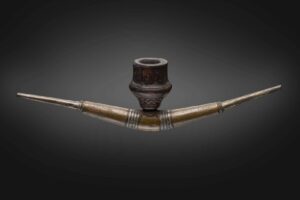 Probably artist in Indonesia, Two-stem smoking pipe, about 1790. Metal and wood. Gift of Captain Jonathan Carnes, 1799. M18. Peabody Essex Museum. This exhibition is one that fosters story telling. Alongside boat models, paddles, natural specimens and works of art and culture from around the world, the interactive installation in East India Marine Hall provides in-depth context for the objects on view. Audio and video storytelling gives voice to the words of early collectors, trading partners, visiting historians, journalists and museum visitors — some extracted from records in the museum’s vast and meticulously kept archive.
 “Storytelling is one of the most exciting aspects of the project because we have centuries of commentary, information, background and historical documentation of these objects that we can now bring to the fore through digital media,” said Finamore. For example, an Indian palanquin, a hand-carried, wheel-less conveyance used to transport a person of import, was gifted to the museum by several ship captains in 1803. Visitors can consider the object from a range of perspectives, from the donors who wanted it to be used in local parades, to the thoughts of a museum visitor in the 19th century, to a contemporary scholar who reflects on traditional Indian practices and provides their own insights. It is a marvelous opportunity to immerse oneself in the wonders and mysteries of the world. For more information, visit www.pem.org
THROUGH JUNE 7: EDMONIA LEWIS…SAID IN STONE
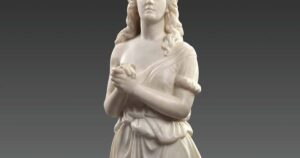 The Peabody Essex Museum (PEM) presents the first major retrospective exhibition co-organized by the Georgia Museum of Art at the University of Georgia and featuring newly conserved and never before publicly exhibited works. This stunning retrospective surrounds the work of acclaimed 19th-century Black and Indigenous sculptor Edmonia Lewis. Extracted from public and private collections across the United States and abroad, 30 sculptures by Lewis have been gathered together and displayed. In addition,a number of objects of various media have been blended within the retrospect. The result creates a wonderful opportunity for visitors to learn of Lewis’ mastery of marble and marvel at her remarkable, storied life. Ms Lewis was born in Greenbush, New York, in 1844, and became the first sculptor of Afro-Caribbean and Anishinaabe descent to achieve widespread international acclaim. Her mother was a member of the Mississaugas of the Credit First Nation, an Anishinaabe nation in present-day Ontario. She was known for her creativity in weaving and embroidery. Her father was a free Black man who may have worked as a gentleman’s servant. Orphaned as a child, Lewis was raised by maternal aunts who profoundly inspired her artistry, teaching her how to work with birch bark and porcupine quills, craft textiles and moccasins and use a range of materials to tell stories. At age 19, Lewis met the abolitionist Frederick Douglass at Oberlin College in Ohio. He recognized her talent and encouraged her to “seek the East.” Thus, in 1863 she moved to Boston where she set up a downtown studio and connected with the city’s most prominent artists and patrons. She formed networks of support with social reformers and abolitionists which influenced her initial artistic successes by creating small portrait medallions of famous American abolitionists which were very popular during the Civil War. in late 1865, Lewis traveled to Rome to join leading American sculptors. There, she continued her commitment to the antislavery cause with works like Forever Free, the first sculpture by a Black artist in the United States to celebrate emancipation.
 Forever Free Alongside a vibrant community of expatriate women artists, she crafted a feminist approach to neoclassical sculpture. Her most ambitious sculpture, The Death of Cleopatra, showed the Egyptian queen defiant in the face of bondage, celebrating female self-determination and the artist’s own fierce independence. Her plaster portraits and vivid, naturalistic stone sculptures depict powerful women, social reformers, Native individuals and religious figures. Through these classically inspired sculptures, Lewis elevated contemporary stories of emancipation, Indigenous sovereignty and religious liberty. “Edmonia Lewis transcended national, racial and gender barriers,” said Jeffrey Richmond-Moll, PEM’s George Putnam Curator of American Art and exhibition co-curator. “Her body of work asserts a unique voice in the history of American art.
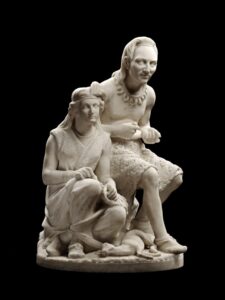
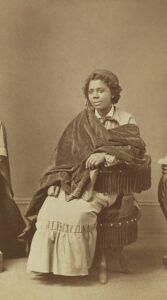 Edmonia Lewis This retrospective exhibition places Edmonia Lewis and her sculptures within the context of pressing social concerns of her time and ours. Together with Native and Black scholars, artists and community members, we also explore how Lewis reconciled her art and her identity in the face of prejudicial laws, shifting public sentiment and competing conceptions of what it meant to be Black and Indigenous in the 19th century.” The exhibition underscores themes of community, reform and resilience and looks at the lifelong impact of both Black activism and Indigenous community on her sculpture practice. “Sometimes the times were dark and the outlook was lonesome, but where there is a will, there is a way,” Lewis recalled in 1878. “That is what I tell my people whenever I meet them, that they must not be discouraged, but work ahead until the world is bound to respect them for what they have accomplished.” The breadth of Lewis’ life’s work emerges through photographs, decorative objects, Indigenous belongings, literature, 19th- and 20th-century art and contemporary works, including recent acquisitions by the London-based interdisciplinary artist Gisela Torres and Serpent River Ojibwa installation artist Bonnie Devine. In-gallery videos and digital interactive engages Lewis’ story with a variety of audiences, while collaborations with Black and Native scholars and academic partnerships with Salem State University deepen understanding of Lewis’ life and work through shared storytelling, dialogue and collective reflection. The Indigenous Artistic Worlds section of the exhibition is anchored by Lewis’ Hiawatha’s Marriage (modeled 1866), that was inspired by Henry Wadsworth Longfellow’s epic poem The Song of Hiawatha.
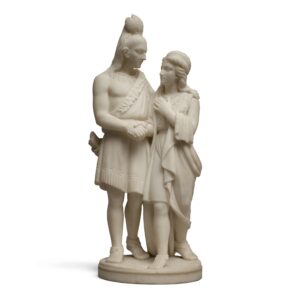 Hiawatha’s Marriage (modeled 1866) This section underscores Anishinaabe artistic traditions as central to Lewis’ creative development, traces her lifelong negotiation of global networks of trade and exchange and reveals how the Native American imagery in her Longfellow-inspired sculptures challenges 19th-century myths of Indigenous disappearance. A section called The Studios of Rome explores the materials and techniques for carving marble sculpture that Lewis learned in Italy and employed throughout her career. Through sculptures, historical photographs and design elements crafted in collaboration with Skylight Studios of Woburn, Massachusetts, this gallery helps viewers understand Lewis’ studio as a space of making, self-promotion and cross-cultural exchange. A recently conserved sculpture, Cupid Caught In A Trap, gives further insight into Lewis’ working methods, in collaboration with objects conservator Amy Jones Abbe and the fabrication expertise of Keystone Memorials of Elberton, Georgia.
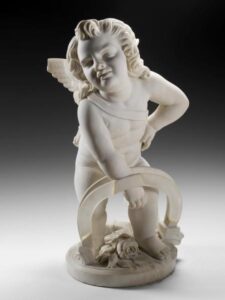 Cupid Caught In A Trap (1872-76) Portrait photographs of the artists by Henry Rocher and Augustus Marshall, along with periodicals, newspaper criticism, portrait busts and other print materials, examine how Lewis publicly asserted her humanity, individuality and determination as an artist. The exhibition’s final section considers religious and mythological subjects, which resonate with Lewis’ activist spirit, her concern for the marginalized and her belief in art and religion as a means of liberation and renewal. These works also reflect the sculptor’s deep ties to Italian and expatriate Catholics after her baptism into the Roman Catholic Church in 1868, and the ongoing support that Christian religious organizations, Protestant and Catholic alike, offered her in the final decades of her career. Lewis died in 1907 and her contribution to American sculpture has largely been under-recognized. Some of her great masterpieces were rediscovered decades later, while others remain lost. Said in Stone features several sculptures by Lewis that have never been exhibited before, along with cutting-edge research that brings to light previously unknown details of her life and career. “Said in Stone is an ongoing project of recovery and rediscovery. My hope is that this exhibition introduces our visitors to Edmonia Lewis’ art and life within the communities that influenced her and vice versa, and within the wider history of American art,” said Richmond-Moll. “There is something for everyone in Edmonia Lewis’ story. We hope visitors will come to appreciate Lewis’ impressive, lasting legacy as an artist who prevailed against all odds.” For more information visit www.pem.org
THROUGH APRIL. 15: ANDREW GN…FASHIONING THE WORLD
 Installation view of the Andrew Gn: Fashioning Singapore and the World exhibition at the Asian Civilisations Museum (ACM), 2023. Image courtesy of Asian Civilisations Museum.
 Image of the designer, Andrew GN adjacent to one of his stunning creations. The Peabody Eseex Museum invites all to come and experience this glittering retrospective of the fashion, art and design mastery of Singaporean designer Andrew Gn. He was named a “pioneer among foreign-born, Paris-based designers” by Vogue. Gn is one of Singapore’s most prolific creative forces, producing more than 80 collections and 10,000 pieces of clothing over 25 years. Now, making its North American debut, this exhibition showcases nearly 100 stunning works, including clothing, accessories, original illustrations and digital media, divided into thematic sections that highlight the designer’s signature blend of Western aesthetics and Asian decorative arts. Andrew Gn: Fashioning the World is organized by the Peabody Essex Museum in collaboration with the Asian Civilizations Museum. www.pem.org
THROUGH SEPT. 27: KNOWING NATURE…STORIES OF THE BOREAL FOREST
 Scenic moonrise. © Gary and Joanie McGuffin/themcguffins.ca The Peabody Essex Museum (PEM) invites you to explore the last remaining stretches of true wilderness. The North American boreal forest is a mega forest that stretches across a third of the continent. The word “boreal” refers to the climatic zone south of the Arctic, especially the cold temperate region that is dominated by forests of birch, poplar, and evergreens. Sitting just below the Arctic Circle, it is home to 3.7 million people, 85 species of animals, 32,000 species of insects and two billion migratory birds.. This exhibition was developed by the Smithsonian Institution Traveling Exhibition Service to encourage an opportunity to explore the biodiversity and global importance of these northernmost forests through first-person stories, commissioned objects, provocative interactive experiences and exquisite photography and videography. This timely bilingual exhibition (in English and Spanish) weaves together themes of climate change, Indigenous perspectives and the relationship between people and nature. Designed to be family-friendly, “Knowing Nature” is on view in PEM’s Dotty Brown Art & Nature Center and is presented as part of the museum’s Climate + Environment Initiative!
 © Gary and Joanie McGuffin/themcguffins.ca “Covering 33% of the Earth’s forested area, the boreal forest is the last intact forest in the world. It is critical to the health of our entire planet, yet many people have never heard of it or don’t know much about it,” said Jane Winchell, the Sarah Fraser Robbins Director of PEM’s Dotty Brown Art & Nature Center. “While seemingly vast and remote, this place is home to more than 300 Indigenous communities, whose knowledge and observations are key to understanding and protecting this environment” From space, the boreal forest looks like a sparkling halo of evergreens and waterways that wraps Earth’s northern latitudes and extends from Europe across Siberia, and from Alaska across Canada. As the world’s largest land biome, the forest helps regulate Earth’s climate, is a critical water reservoir and holds two to three times as much carbon as tropical forests. Additionally, it is an essential breeding ground for billions of migratory songbirds and waterfowl and home to wolves and grizzlies as well as the last great herds of barren-ground caribou.
 Caribou walking. Photo courtesy Stephen Loring The exhibition is organized through the seasons, presenting the forest in its four cycles of beauty and importance as a wetland region, home to migratory birds, people and other animals. Visitors will encounter first person narratives from scientists, artists and the indigenous community. Works by contemporary artists made for this exhibition to demonstrate ongoing culture from the region include Cree birchbark artwork, handmade snowshoes and contemporary jewelry plus PEM commissioned works by 2023 NEA Heritage award recipient Elizabeth James-Perry (Aquinnah Wampanoag) who engages with Northeastern Woodlands Native cultural expressions, primarily in sculptural forms ranging from quill work to cedar bark weaving to wampum shell-carving and bead-making with its connection to identity and sovereignty, maritime traditions and restorative Native gardening. Also featured is an 1803 Wabanaki birch-bark canoe model from PEM’s collection, as well as a 2022 watercolor of the boreal forest by Kristina Anderson-Teixeira. A family activity guide, in both English and Spanish, accompanies the exhibition and the interactive offerings include a migratory bird challenge, touchable works, a hands-on animal track table, and A Boreal Balance digital game, among others. An Immersive Forest Experience features an 8-channel birdsong soundscape that will put visitors right inside the forest. “We are thrilled to share the sights, sounds, textures, and stories of the boreal forest,” said Winchell. “A learning journey that starts with curiosity, builds empathy and leads to action. We are all connected to the boreal forest and our health and well being are tied to its future. The vastness, beauty, and solitude of this landscape touches something deep within us. It provides a place of hope in a changing world.” Visit www.pem.org
THROUGH JAN. 3, 2027: ON THIS GROUND …BEING AND BELONGING IN AMERICA

The Peabody Essex Museum located at 161 Essex St. in Salem is opening for the first time, this long term retrospective that surrounds a blend of Native American art and and art from their American collections. More than 250 historical and contemporary works have been extracted from the museum’s vast personal collections, These works of art and artifacts span over more than 10,000 years offering a range of voices, actually modes of expression gleaned from all cultures., The media presented includes sculpture, paintings, textiles and costumes, furniture, decorative arts, works on paper, installations, photography, video, and a re-envisioned period room. All these help to place in context what it means to belong to a community, a place, a family and a nation that has routinely been expressed through numerous works manifested in diverse culture. On This Ground responds to the urgent needs of our time for individuals to embrace the understanding and necessity of community. This is provided with this unique opportunity to express the complexity of our combined histories. By doing so it strives to focus on a future that hopefully will bring more connection and empathy within the multiple cultures. Lynda Roscoe Hartigan, PEM’s Rose-Marie and Eijk van Otterloo Executive Director and CEO stated, “Placing these two significant collections in direct dialogue and giving them equal emphasis in a gallery space at this scale is unprecedented among American museums and underscores that the American experience is unimaginable without the inclusion of Native American art, history and culture.” Thus this exhibition helps us understand what it means to belong to family, community, and this place we now call America. By bringing two extraordinary collections of Native American and American art together for the first time in our institution’s history the installation will be responsive to these urgent times by giving our public an opportunity to grapple with the links, continuities, and disjunctions of our complex histories in America in order to shape a more connected and empathetic present and future.” The lead sponsorship is provided by The Henry Foundation, a leader in art funding since 1982. Additional generous support is provided by the TERRA Foundation, The Ellen and Stephen Hoffman Endowment for the Native American Art Department and The Andrew W. Mellon Foundation. In addition PEM gratefully acknowledges the support of the Native American Fellowship Program. For more information visit www.pem.org
ONGOING: YU-Kil-CHUN GALLERY of KOREAN ART and CULTURE
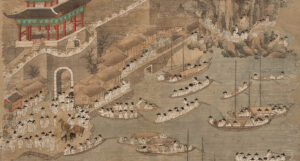 Artist in Korea, Welcoming Banquet of the Governor of Pyeongan (detail), early 1800s. Ink and color on silk. Museum purchase, made possible in part by W.C. Endicott and George A. Peabody, 1927. E20262.A-H. Peabody Essex Museum. © Samsung Foundation of Culture. Courtesy of the Leeum Museum of Art. Photo by Kim Hyunsoo, K2 STUDIO. The Peabody Essex Museum has opened this landmark installation surrounding the museum’s remarkable Korean collection. PEM is the oldest continuously operating museum in the United States and is also the first American institution to collect Korean art. Thanks to the support from the Korea Foundation and other generous funders, including the National Museum of Korea, who also support PEM’s Curator of Korean Art position. Visitors will see key works of art that reflect life in Korea from the late Joseon dynasty (1392–1910) and early 20th century — a period of cross-cultural connection and transformation — through to the present day. These early works, often rare and one of a kind, vividly show how people lived and interacted with each other in Korea, as well as exemplify their thoughts, values and dreams. Visitors will also see how Korean artists navigated global waves of change and expressed their struggles and aspirations through resourcefulness and innovation. Resilience and creativity have been integral to Korea throughout its history, and these values continue to shape the global influence of Korean culture today. The Yu Kil-Chun Gallery will be an ongoing collection installation that honors PEM’s ties to Korea and will be the only gallery in the country to focus on early 19th- and 20th-century Korean art,” said Lynda Roscoe Hartigan, PEM’s Rose-Marie and Eijk van Otterloo Executive Director and CEO. “PEM’s Curator of Korean Art, Dr. Jiyeon Kim, has conducted thorough research on our historic collection, uncovering fascinating human stories, and has made significant acquisitions of modern and contemporary Korean artworks, further enriching the collection. Through these efforts, this project not only extends and deepens the historical partnership between the museum and Korea but also invites us to reconsider contemporary culture and the global experience through a fresh perspective. “The Yu Kil-Chun Gallery extends and expands upon a historically significant partnership between the museum and Korea and encourages us to consider our contemporary culture and experience of globalism through a new lens.”
 Artists in Korea, Hwarot (bridal robe) (detail), 1700s or 1800s. Silk, paper, and cotton. Gift of Yamanaka and Company, 1927. E20190.F. Peabody Essex Museum. PEM’s Korean collection began in the late 19th century under Edward Sylvester Morse, director of the museum’s predecessor organization, the Peabody Academy of Science. During his almost 40-year tenure, Morse was determined to bring Korean culture to the United States.
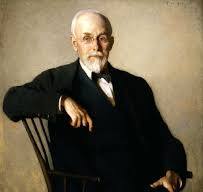 Frank Weston Benson, Portrait of Edward Sylvester Morse, 1913. Oil on canvas. Gift of Edith Owen Robb, 1914. M4311. Peabody Essex Museum. In addition to gifts from Korean diplomats, Morse imported more than 200 objects from Korea in 1883, forming the basis of PEM’s Korean collection. One of the most important groups of works Morse acquired is a set of ten Korean musical instruments exhibited at the World’s Columbian Exposition of 1893, also known as the Chicago World’s Fair.
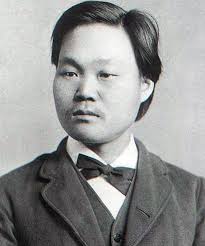 A. B. Cross Photography Studio, Salem, Massachusetts, Portrait of Yu Kil-Chun, 1883-1884. Albumen print. Phillips Library. Edward Sylvester Morse Papers. E2, box 88 3 Japan, ETH000031. Yu Kil-Chun (1856-1914), a member of the first Korean diplomatic delegation to the U.S. in 1883 and the first Korean international scholar in America, played a crucial consulting role in growing PEM’s collection of Korean art and culture. Yu Kil-Chun’s stay in the Salem area from 1883 to 1884 solidified an enduring friendship with Morse. Before Yu Kil-Chun departed the United States to return to Korea, he donated his personal belongings to the museum. A few years later, Charles Goddard Weld assisted the museum with the purchase of Korean works from Gustavus Goward, a diplomat who served in Korea and other parts of the Pacific Rim. In the early 20th century, PEM purchased nearly 100 Korean pieces to add to its already significant collection. PEM’s collection emphasizes works that reflect the prominence of Korean women artists and artisans in textiles, basketry and paper-mâché objects. It continues to grow and diversify thanks to important acquisitions, including fine mid-Joseon mother-of-pearl inlaid lacquer-ware, a Nectar Ritual painting from 1744 (a remarkable example of a late Joseon religious painting), an exquisite 19th-century folding screen depicting a Banquet of Queen Mother of the West and the recent acquisition of four works by Nam June Paik, including the 2001 multimedia work Ceramic Vessel and Mirror from 1998.
 Artists in Korea, Hwarot (bridal robe), late 18th century. Silk and rice paper. Gift of Yamanaka and Company, 1927. E20190.F. Peabody Essex Museum. “PEM’s Korean Art and Culture collection is brimming with compelling stories of Korea’s early interactions with the West, as told by various voices, from the artists themselves to collectors and advisors,” said Dr. Jiyeon Kim, PEM’s Curator of Korean Art. “Visitors will have a rare opportunity to see how Koreans lived in the 19th and early 20th centuries and understand how their lived experience helps tell a larger story of global exchange, cultural change, resilience and personal expression.” PEM’s Yu Kil-Chun Gallery of Korean Art and Culture will feature about 100 works, including major examples from the museum’s renowned Korean textile collection, superb 19th-century paintings and the painted screen Welcoming Banquet of the Governor of Pyeongan, which depicts eight spectacular moments from lavish official celebrations. This set of paintings, originally made as one magnificent folding screen, came to PEM as eight separate panels and has been recently conserved. The installation will also feature a newly commissioned media work by the South Korean artist Yang Sookyun (born 1982) and other inspiring contemporary works by Korean and Korean American artists. The Yu Kil-Chun Gallery of Korean Art and Culture has been made possible with the support of the Korea Foundation. Generous support is also provided by the National Museum of Korea; The E. Rhodes and Leona B. Carpenter Foundation; the Overseas Korean Cultural Heritage Foundation; the Samsung Foundation of Culture, Korea; the Henry Luce Foundation; the Korean Cultural Center, Washington, D.C.; the Korean Cultural Society of Boston; an anonymous donor; Linda Champion; Mrs. Yu; and other generous donors. For further informaton visit www.pem.org
ONGOING: FASHION AND DESIGN GALLERY
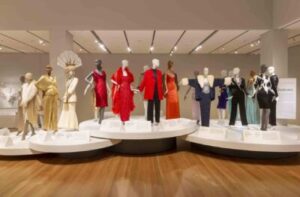 The Peabody Essex Museum (PEM) has reopened this stunning exhibition which now features the influence of Boston Entrepreneur, Yolanda Cellucci. In 1968, entrepreneur Yolanda Cellucci entered Boston’s fashion scene and changed it forever. The city’s retail fashion scene at the time was robust, so Cellucci forged a business model focused on women’s wear and self-care in a holistic, head-turning way. Her shop Yolanda’s, based in Waltham, Massachusetts, became a hotspot for lavish evening and wedding ensembles. In addition to offering high-profile American and international designs, including pieces by Hollywood favorite Bob Mackie, the store provided style consultations, personal shopping, cosmetology services and a day spa with light refreshments — all under one roof. Throughout the late 20th century, “Yolanda’s” became a household name throughout the region and a watchword for glitz and glamor.
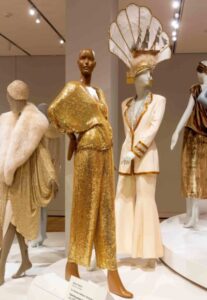 Fashions from Yolanda Cellucci’s collection In 2021, Cellucci generously donated her collection of 57 works of fashion and accessories to PEM, along with archival photographs and materials related to the legacy of Yolanda’s. “PEM is honored to be the steward of this singular and highly memorable chapter of fashion history,” said Petra Slinkard, PEM’s Director of Curatorial Affairs and The Nancy B. Putnam Curator of Fashion and Textiles. “With an eye for all things dazzling, Yolanda Cellucci influenced so many women’s lives by encouraging them to embrace their own power and without apology gain atention as they stepped out into the world,” added Paula Richter, PEM’s Curator overseeing the Yolanda Cellucci collection.
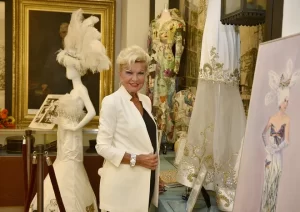 Yolanda Cellucci Throughout her career, Cellucci hosted fashion shows and galas, showcasing her merchandise and raising funds for charities focused on healthcare, the arts and education. Events at Yolanda’s influenced Boston’s society pages for decades. Now in her 80s, Cellucci continues to make an impression through her cable access TV show, a recently published autobiography Beyond the Glitz and Glamour and a series of books written in her daughter’s memory, Lindy Lou and her Dancing Shoes. PEM’s Fashion and Design gallery, located on the third floor of the museum’s new wing, now boasts more than 100 fresh works from the museum’s global fashion and textile collection, including nearly 40 recent acquisitions that spotlight the vibrant and flamboyant collection of Yolanda.. PEM’s Fashion & Design Gallery also features more than 180 examples of contemporary and historic dress, as well as textiles, accessories, sculpture, studio glass and decorative arts and furniture drawn from PEM’s vast and storied collection. Various objects will be rotated into the gallery such as thirteen new ensembles in the Carl & Iris Barrel Apfel Gallery.;
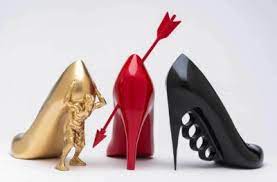 Shoes from PEM’s renowned footwear collection…the largest in the U.S.; works that focus on China’s influence and fashion’s use of the iconic dragon symbol,; objects that speak to the notions of intimidation and empowerment such as fashions by Donna Karan, a rare Salem Zouave uniform, a Nick Cave Soundsuit and the likeness of a Samurai warrior; and a section looking at body modification that includes an 18th century corset paired with a work from the Fall/Winter 2016 collection from the Parisian fashion house;, along with never before-exhibited jewelry from India, Singapore, Myanmar and Indonesia. For more information visit www.pem.org
IN ADDITION TO THE ABOVE THERE ARE NUMEROUS VIBRANT AND DIVERSE ONGOING EXHIBITIONS ON DISPLAY AT THE PEM! (www.pem.org)
>>>>>>>>>>>>>>>>>>>>>>>>>>>>>>>>>>>>>>>>>
MUSEUM OF FINE ARTS BOSTON For complete museum and exhibition details visit www.mfa.org
FYI: FIVE DOLLAR ENTRY EVERY THIRD THURSDAY This fall the MFA also launches $5 Third Thursdays, offering $5 minimum, pay-what-you-wish admission after 5 pm on the third Thursday of every month. Visitors are invited to explore the galleries until 10 pm and enjoy special programming ranging from community celebrations to musical performances.
NEW GALLERIES OF MODERN ART NOW OPENED
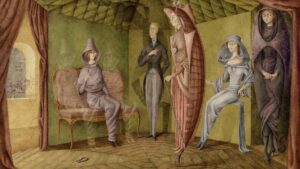 Remedios Varo, Tailleur pour dames (detail), 1957. Oil on board. Museum purchase with funds by exchange from the Alfred Stieglitz Collection—Bequest of Georgia O’Keeffe, and a Gift of the Stephen and Sybil Stone Foundation. © 2025 Remedios Varo, Artists Rights Society (ARS), New York / VEGAP, Madrid. Four new spaces have been unveiled on the first floor of the Museum’s Evans Wing. Each is showcasing works from the 20th century that include highlights from the MFA’s collection, new acquisitions, and rarely seen loans from private holdings. Together with a second-floor gallery dedicated to 20th-century sculpture, which opened in June 2025, these new spaces represent the MFA’s first re-envisioned presentation of modern art in a generation. This major renovation project was made possible by a $25 million gift from the Wyss Foundation, which also funded two new staff positions for a curator and conservator of modern art.“Opening these new galleries marks an important moment for the MFA. The spectacular installation showcases a previously underrepresented area of the Museum’s collection and encourages new and exciting ways of thinking about modernism,” said Pierre Terjanian, Ann and Graham Gund Director. “We’re looking forward to visitors (exploring) these new spaces so they can make meaningful connections—from bold 19th-century precursors to the 20th-century explorations that created the foundation for today’s contemporary art. We’re grateful to Hansjörg Wyss and his Foundation for supporting the project and bringing it to fruition.” The new galleries feature nearly 60 paintings, sculpture, and drawings from about 1900 to 1970. In addition to 24 works from the MFA’s collection—including six new and recent acquisitions by Gertrude Abercrombie, Jorge Camacho, George Minne, Piet Mondrian, and Remedios Varo—the opening installations feature 33 loans, 31 of which have not been shown at the MFA before. These include four paintings by René Magritte as well as works by Alexander Calder, Alberto Giacometti, Wassily Kandinsky, Paul Klee, Henri Matisse, Joan Miró, Francis Picabia, and Mark Rothko.“These spaces consider modernism across geographies, introduce our visitors to new narratives, and re-contextualize collection favorites,” said Claire Howard, Hansjörg Wyss Curator of Modern Art. “They offer a range of ways of understanding this dynamic period.”Two of the new first-floor galleries are organized thematically, one offering an exploration of color and spirituality in modern art and the other focusing on the Surrealism movement. The opening installations in the additional galleries—on view through June 2026—present unique dialogues between two pairs of artists: Giacometti and Rothko, and Calder and Klee. In June 2026, new rotations will focus on international Cubism and postwar abstraction. Three galleries—including the gallery dedicated to modern sculpture, which opened earlier this year—are named after Hansjörg Wyss and his late wife, Rosamund Zander. The philanthropist, who is an Honorary MFA Advisor, attended Harvard Business School and established the Wyss Foundation in 1998, providing support in areas including conservation, economic opportunity, medical advancements, education, and the arts. Zander was an artist, best-selling author, environmentalist, and lifelong MFA visitor.
MARCH 15 – JUNE 28: FRAMING NATURE…GARDENS AND IMAGINATION
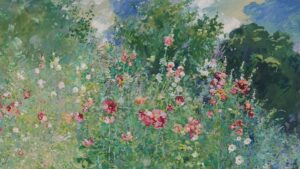 Ross Sterling Turner, A Garden Is a Sea of Flowers, (detail), 1912. Transparent and opaque watercolor on board. Gift of the Estate of Nellie Parney Carter. After this long and tedious winter the Museum of Fine Arts Boston invites all to come and visit this refreshing exhibition in the Ann and Graham Gund Gallery. It is filled with glorious works of exquisite garden images from their global collection. A plot of land, a relaxing retreat, a formal landscape, even a place of loving constant labor, gardens can carry a range of associations, especially as expressed in the world of art. This exhibition explores striking similarities and differences across time as well as places. Visitors will see both beloved favorites along with previously unseen masterpieces. These all center on the garden, a fertile place for human creativity and imaginative possibility. Works ranging from wall-sized tapestries and intricately detailed Chinese scrolls all give the illusion of garden spaces. Even modern and contemporary prints, drawings, photographs, and paintings bring visitors on an immersive journey through a variety of cultivated and natural worlds. The exhibit reminds us how we can relate to the outdoors, shape garden spaces through cultivation, care, and labor, and express this universal human impulse through art. “Framing Nature” coincides with the 50th anniversary of Art in Bloom—a beloved tradition that takes place at the MFA every spring. Although exhibition tickets are included with general admission to the Museum, everyone needs a timed-entry ticket to see the exhibition, including members. Thus, please reserve your tickets to guarantee entry. Generous support is provided by Penny Vinik. Additional support is provided by Nancy and Michele Kolligian in memory of their mother Rose V. Kolligian, the Laura and Tait Nielsen Exhibition Fund, the James & Virginia Welch Foundation, the Loring Textile Gallery Exhibition Fund, the Wendy Lipsey Ecker and Family Exhibition and Publication Fund for Fashion, Textiles and Jewelry, the Patricia B. Jacoby Exhibition Fund, and the Ellen and Robert Jaffe Fund. For more information visit www.mfa.org
THROUGH MAY 3: ONE HUNDRED STITICHES…THE BEAUTY OF PATCHWORK FROM RURAL CHINA
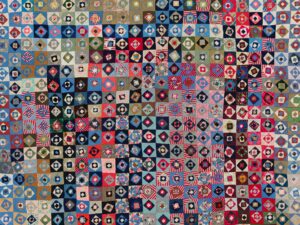 Unidentified artist, bed cover, Chinese, about 1970s. Cotton and synthetics, hand-sewn patchwork. Joel Alvord and Lisa Schmid Alvord Fund. In rural Chinese villages today, women are creating dynamic patchwork textiles, as their mothers and grandmothers did before them. This art form, which evolved from ancient Buddhist and Daoist customs of monks dressing in patched rags to project a sense of humility, is rooted in practicality, with the fabrics serving as bed and window covers, door curtains, and children’s clothing. The vibrant abstract compositions demonstrate creativity and fine artistic sensibilities that flourish far beyond the borders of established Chinese art canons. One Hundred Stitches, One Hundred Villages: The Beauty of Patchwork from Rural China at the Museum of Fine Arts, Boston (MFA), presents nearly 20 kaleidoscopic Chinese patchwork textiles, which are rarely seen outside the villages where they are made. The textiles, coming from the Hebei, Shanxi, Shandong, Gansu, and Shaanxi provinces, reveal a wide variety of compositions, patterns, and techniques, which reflect local styles and individual aesthetics alike. Visitors can explore the historical impacts on materials and designs, and discover the personal histories and artistic intuitions behind the works. Improvising with available cloth, riffing on patterns, and injecting their own creativity, the makers have produced stunning and inspiring imagery. Though viewers familiar with American quilt patterns may be surprised to notice many similar designs, these Chinese works represent a tradition all their own. Nancy Berliner, Wu Tung Senior Curator of Chinese Art and exhibition curator, traveled to many villages in northern China, interviewing artists and collecting the works on view here for the MFA’s collection directly from the makers and their descendants. Photographer Lois Conner accompanied her, documenting the multiple trips through images and film—featured in the exhibition—of the artists, villages, and objects in their original environments. One Hundred Stitches, One Hundred Villages is accompanied by the first English-language publication on the art of Chinese patchwork textiles, authored by Berliner and with photographs by Conner. A fact sheet for the exhibition is available in English and Chinese.This exhibition is generously supported by the Tan Family Education Foundation
THROUGH JULY 13: FACES IN THE CROWD…STREER PHOTOGRAPHY
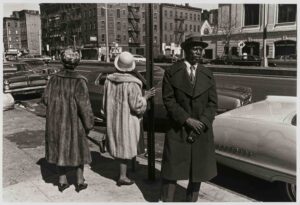 Dawoud Bey, A Man and Two Women After a Church Service, 1976. Gelatin silver print. Gift of David W. Williams and Eric Ceputis. © Dawoud Bey. The ubiquity of camera phones today has very much made all the world a stage. In the modern city, photographers are now less concerned with surreptitiously capturing an image and much more likely to collaborate with their subjects in the street. Drawn to photography’s narrative potential, many employ the camera as a tool of transformation, taking everyday pictures from the ordinary to the strangely beautiful or even ominous.Faces in the Crowd: Street Photography at the Museum of Fine Arts, Boston (MFA), explores the evolving techniques photographers have used to record the human experience as it has played out in populous urban spaces—from Harlem and Los Angeles to Tokyo and Istanbul—over five decades. Photographs from the 1970s through the ’90s by the likes of Garry Winogrand, Helen Levitt, Dawoud Bey, Stephen Shore, and Yolanda Andrade appear alongside more recent work by artists such as Luc Delahaye, Katy Grannan, Amani Willett, Zoe Strauss, and Martin Parr. These images create a compelling visual conversation that encourages visitors to consider developments in photography as well as changes in cities and societies at large. The ubiquity of camera phones today has very much made all the world a stage. In the modern city, photographers are now less concerned with surreptitiously capturing an image and much more likely to collaborate with their subjects in the street. Support is provided by the Shelly and Michael Kassen Fund. For more information got to www.mfa.org
THROUGH DEC. 13: INTENTIONAL BEAUTY…JEWISH RITUAL ART FROM THE COLLECTION
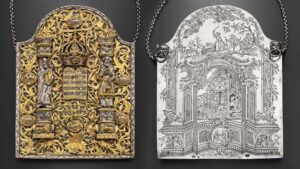 Elimelekh Tzoref, Torah shield, 1781–82. Silver and parcel gilt with enamel, niello, and stones. Museum purchase with funds donated by the Phillip Leonian and Edith Rosenbaum Leonian Charitable Trust, Jacques Aaron Preis, Trustee. The Museum of Fine Arts, Boston (MFA), opens Intentional Beauty: Jewish Ritual Art from the Collection in the Bernard and Barbara Stern Shapiro Gallery in the Art of the Americas Wing. It is the first gallery devoted to Jewish ritual art, or Judaica, at the MFA and in New England. Bringing together 27 objects from Asia, North Africa, Europe and the U.S., the gallery showcases ceremonial items created for the Jewish religious experience that were utilized both at home and in the synagogue. Twenty of these objects are on view at the MFA for the first time. The vast majority of new acquisitions speak to the remarkable geographic and cultural diversity of the Jewish people. This new installation features metalwork, textiles, paintings, furniture and works on paper. This newly dedicated space complements the MFA’s longstanding commitment to integrating Judaica objects and stories across the Museum’s collection galleries, creating dialogues with different cultures and inviting visitors to deepen their engagement. This exhibition is sponsored by the David Berg Foundation. Additional support provided by Lorraine Bressler, the Rita J. and Stanley H. Kaplan Family Foundation, Inc., Lisbeth Tarlow and Stephen Kay, and The Priebatsch Family Fund, in loving memory of Norman Priebatsch. With special gratitude to Marcia and Louis Kamentsky and the Charles and Lynn Schusterman Family Foundation. For more information visit www.mfa.org
ONGOING: COUNTER HISTORY…CONTEMPORARY ART FROM THE COLLECTION
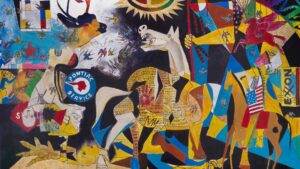 Artists often question our shared history as they frame ways for us to understand it differently. This exhibition includes many new acquisitions and offers multiple possibilities to reconsider the past through the art of our time. Three interrelated thematic sections make up this impactful display. “Monuments” focuses on the ways artists use grand scale, references to painful histories, and images of power and control to speak to collective memory and immortalize the past. As much as museums, libraries, and other repositories officially serve to document the past, many other ways of recording history—from ephemeral chronicles to spoken word, for example—present themselves in “Unofficial Archives.” By documenting injustices, repression, and state violence through individual experience, the work in “Counter Histories” stands against official records and sets false narratives straight. Over several planned rotations, the installation brings together more than 70 artists and 140 artworks. Longtime highlights of the collection by artists such as Mark Bradford, Jeffrey Gibson, Mona Hatoum, Jasper Johns, Alice Neel, Kiki Smith, and Andy Warhol are placed in dialogue with emerging practices and fresh acquisitions by Dana Chandler Jr., Sharon Hayes, Steve Locke, Laurel Nakadate, Tammy Nguyen, and Avery Singer. Generous support for “Counter History: Contemporary Art from the Collection” and “Rituals for Remembering: María Magdalena Campos-Pons and Ana Mendieta” is provided by the Abrams Foundation and the Henry and Lois Foster Fund for Contemporary Exhibitions. Additional support comes from Linda Mason and Roger Brown, the Amy and Jonathan Poorvu Fund for the Exhibition of Contemporary Art and Sculpture, the Diane Krane Family and Jonathan and Gina Krane Family Fund, the Barbara Jane Anderson Fund, and the Leigh and Stephen Braude Fund for Latin American Art. For further information visit www.mfa.org
NOW OPEN: BEYOND BRILLIANCE: HIGHLIGHTS FROM THE JEWELRY COLLECTION
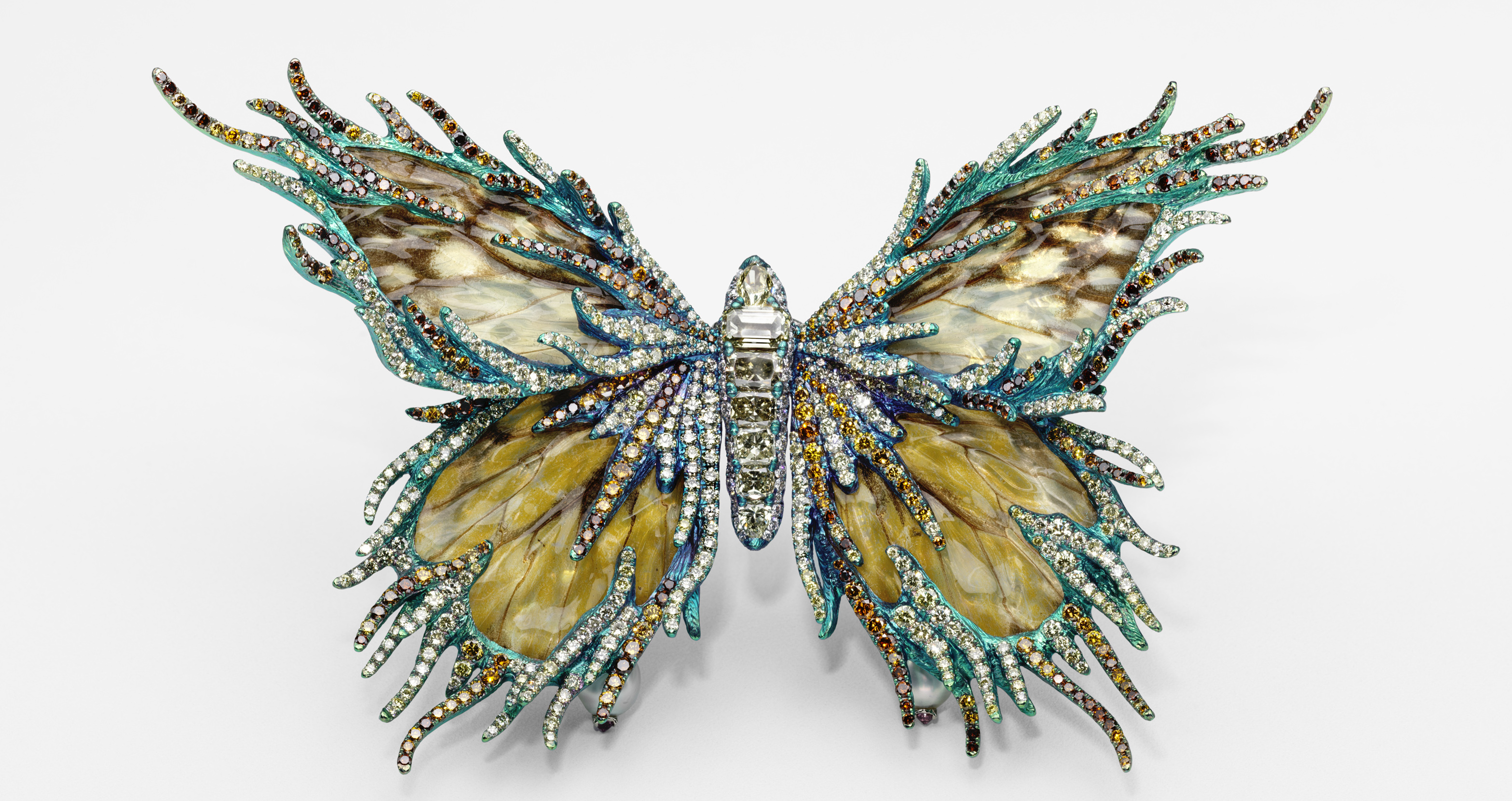 Wallace Chan, Forever Dancing – Bright Star, 2013. Yellow diamond, fancy colored diamonds, rock crystal, mother-of-pearl, butterfly specimen, pearl, and titanium. Gift of Christin Xing and Rex Wong. Reproduced with permission. Believed to be one of the earliest art forms, examples of jewelry date back more than 100,000 years and tell complex stories about human history. The newly renovated Rita J. and Stanley H. Kaplan Family Foundation Gallery features 150 highlights from the Museum’s world-renowned jewelry collection. The gallery spotlights ancient artifacts, fine jewelry, costume jewelry and jewelry by contemporary artists while exploring themes of decorative arts, adornment and messaging. Highlights include an ancient Egyptian broad collar necklace; 19th-century works by Castellani and Carlo Giuliano; 20th-century designs by Marcus & Co., Tiffany & Co., and Bulgari; René Boivin’s starfish brooch from 1937; and fashion jewelry by Chanel, Dior, and Elsa Peretti. Also featured are new acquisitions of contemporary jewelry by Christian and Yasmin Hemmerle, Wallace Chan and Feng J. With ornaments crafted over 4,000 years and reflecting global cultures, Beyond Brilliance: Highlights from the Jewelry Collection champions the great depth and breadth of the MFA’s collection. The exhibition is presented in a jewel box-inspired space, organized into thematic groupings. First area surrounds the Decorative Arts section includes outstanding examples of 19th-and 20th-century design movements like Art Nouveau, Arts and Crafts, Art Deco, Surrealism and Modernism, demonstrating the deep connection between artistic expression and jewelry. Offering an expanded look at materials used to make jewelry, this section features jewelry made in gold and silver, diamonds, colored gemstones, pearls and plastics. Extraordinary craftsmanship and the mastery of materials are seen in techniques like micromosaic, granulation and enamel.
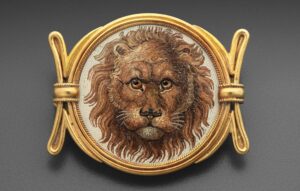 Castellani, micromosaic lion brooch, about 1870. Gold and glass (micromosaic). Gift of Susan Beth Kaplan. New acquisitions in this section include a brooch fashioned with the rare Paraiba tourmaline gemstone by Feng J (2021).
The next area is dedicated to Adornment which emphasizes jewelry’s connection to the body and clothing to remind visitors of the creative ways that it has functioned as part of global visual culture spanning thousands of years. For the opening of the gallery, the paper rotation features two 1920s fashion plates to demonstrate how jewelry and fashion function together to create an overall look. This section celebrates new acquisitions by Anna Hu, twentieth-century designs by Marcus & Co. and Bulgari along with fashion jewelry by Chanel and Dior. And, finally, the Messaging section explores how jewelry can be used to communicate—whether to tell private, personal stories or indicate rank, marital status or religious beliefs. This space includes jewelry formerly worn by First Lady Mary Todd Lincoln,
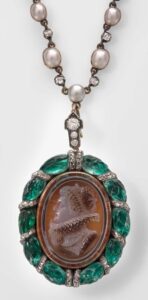 a necklace by Charlotte Newman featuring the profile of Elizabeth I and a turquoise eagle brooch presented by Queen Victoria to each of her train bearers on her wedding day. A pair of earrings by Hemmerle include the Bavarian crown, paying tribute to the German jeweler’s heritage. Additionally, a center case in the gallery will rotate annually, featuring objects that together illustrate the timeless human desire to self-fashion, collect and create. The first rotation pays tribute to Italian designer Elsa Peretti, who died in 2021 and is remembered with such designs as the Open Heart pendant and Bone Cuff bracelets. She is one of the 20th century’s most important designers. For more information regarding this stunning retrospective surrounding the fine art of jewelry, visit www.mfa.org
NOW OPEN: NEWLY TRANSFORMED ARTS OF JAPAN GALLERIES
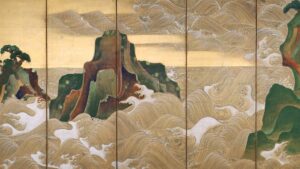 Ogata Kōrin, Waves at Matsushima (detail), 18th century. Six-panel folding screen; ink, color, and gold on paper. Fenollosa-Weld Collection The collection of Japanese art at the Museum of Fine Arts, Boston (MFA), is one of the most comprehensive in the world. Five newly transformed galleries showcasing nearly 200 highlights—including painting, sculpture, decorative arts and selections from the Museum’s vast collection of ukiyo-e prints opened May 11th. Displays will change regularly, presenting icons of the collection and new acquisitions—giving visitors the opportunity to see even more works in a setting that honors and celebrates Japan’s rich history and cultural legacy. The renovations are made possible through the generosity of a community of supporters including individuals, families and corporate partners.The new Arts of Japan galleries include the Japanese Buddhist Temple Room—a visitor favorite— which originally opened in 1909. The contemplative space has been fully renovated and features seven sculptures that have undergone extensive conservation treatment beginning in 2018. A ritual to rededicate the gallery took place on May 11, conducted by a delegation of monks from Miidera, one of the largest temples in Japan. The ritual was simulcasted from the Temple Room to the MFA’s Remis Auditorium, and the monks greeted the public afterward, inviting visitors to explore the newly opened galleries. The MFA has a historic relationship with Miidera, where the early founders of the Museum’s Japanese collection—Ernest Fenollosa, William Sturgis Bigelow and Okakura Kakuzō—studied Tendai Esoteric Buddhism. It is also where Fenollosa and Bigelow are buried today. “The story of Japanese art at the MFA is ever-evolving, and we’re excited to present this next chapter,” said Anne Nishimura Morse, William and Helen Pounds Senior Curator of Japanese Art. “We’re very fortunate to have a truly remarkable collection here in Boston, which was the first of its kind in the U.S. when it was established in 1890 and has since grown into the largest outside Japan. I’m very excited for visitors to see some of their old favorites and discover new works in these galleries, which span from historical to contemporary masterpieces.” The renovation of gallery 280 was made possible with generous support from Caroline and John Rutherfurd. The renovation gallery 278A of the Buddhist Temple Room was generously supported by UNIQLO USA, the Vance Wall Foundation, the Massachusetts Cultural Council, Lisbeth Tarlow and Stephen Kay, Bettina Burr, Dainippon Sumitomo Pharma Co. Ltd., and Mr. and Mrs. Charles C. Cunningham Jr. For further information visit www.mfa.org
CURRENTLY: MICHAELINA WAUTIER EXHIBITION IN THE AMERICAS
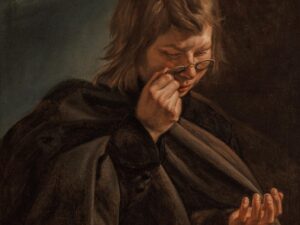 The Center for Netherlandish Art at the Museum of Fine Arts, Boston presents the first exhibition in the Americas dedicated to the art of Michaelina Wautier (1614–1689), a painter from Brussels all but forgotten until the recent rediscovery of her work. Now on view, the exhibition is centered around her rare series The Five Senses (1650), a set of five pictures that were virtually unknown until it was acquired by Rose-Marie and Eijk van Otterloo and lent to the MFA in 2020. They are joined by Wautier’s remarkable Self-Portrait (above) on loan from a private collection and on public view in the U.S. for the first time. Wautier’s technique, process and training are mysterious. Few records about her life exist, due in part to her gender. This exhibition, organized by the MFA’s Center for Netherlandish Art in collaboration with a professor and six doctoral students from Brown University, presents new scholarship about the artist and her unusual career as a female painter working in mid-17th-century Brussels. The Five Senses and the Self-Portrait, all of which have only been attributed to Wautier in recent years, are among fewer than 40 known works by the artist. Wautier focuses on boys—a different model in each painting—performing everyday activities in her detailed portrayals of Sight, Hearing, Smell, Taste and Touch. Accompanying prints by her predecessors and contemporaries, including Cornelis Cort (1533–1578) and Johannes Gillisz. van Vliet (about 1610–about 1640), demonstrate Wautier’s originality, showcasing how she defied a convention at the time of depicting the senses as experienced by idealized women. In her Self-Portrait, Wautier presents herself both in a formal aristocratic setting and as a professional artist, facing an easel and holding painting tools. Together, these extraordinary pictures are exemplary of Wautier’s unique style and brushwork. Additionally, the exhibition features a print after a now-lost portrait by Wautier from the MFA’s collection that has never been on view. Michaelina Wautier and the Five Senses: Innovation in 17th-Century Flemish Painting is accompanied by the first volume of the digital publication series CNA Studies, available on mfa.org and featuring essays by the six organizing students: Yannick Etoundi, Sophie Higgerson, Emily Hirsch, Regina Noto, Mohadeseh Salari Sardari and Dandan Xu is edited by Professor Jeffrey Muller. The exhibition and the Center for Netherlandish Art’s Gallery for Innovative Scholarship is sponsored by Northern Trust. Additional support from the Government of Flanders – Flanders Investment & Trade. Further information may be found at www.mfa.org
IN ADDITION THERE ARE OVER 26 ONGOING GALLERY HIGHLIGHTS TO EXPLORE AT THE MFA…
>>>>>>>>>>>>>>>>>>>>>>>>>>>>>>>>>>>>>>>
MassART ART MUSEUM (MAAM)….For complete museum and exhibition details visit www.maam.massart.edu/visit
THROUGH MAY 31: MASAKO MIKI…MIDNIGHT MARCH
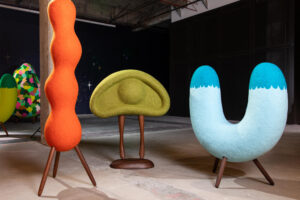 The MassArt Art Museum (MAAM) located inside the campus of the Massachusetts College of Art and Design at 621 Huntington Ave. in Boston brings this exhibition that has taken over MAAM’s second floor Paine Gallery turning it into a fantastical immersive world inspired by the Japanese folktale…Hyakki Yagyō…meaning the Night Parade of One Hundred Demons. It draws from Japanese folklore and Shinto animism, Masako Miki reimagines yōkai—supernatural beings historically depicted as monstrous or threatening—as well as complex, playful, and empowered figures. Born in Osaka, Japan, and now based in Berkeley, California, Miki creates vividly hued, needle-felted wool sculptures that gather in a collective procession of resistance, joy, and transformation. Traveling from its stunning debut at the Institute of Contemporary Art San Francisco (ICA SF), Masako Miki: Midnight March has been adapted to be a fully site-responsive exhibition for MAAM. Taking advantage of MAAM’s 18-ft tall viewing balcony, the exhibition takes over the walls and floor of the museum to dynamically engage MAAM’s architecturally unique Paine Gallery, into a fluid mythological landscape. Midnight March invites visitors to move at the same scale as the figures, becoming part of a shared journey that celebrates difference and bridges past and present, myth and lived experience. Spring 2026 programs extend both exhibitions beyond the gallery with a season of inclusive, hands-on, and inter-generational experiences. Visitors are invited to engage through artist talks, collaborative making, student-led gallery conversations, and festive evening events that center togetherness, storytelling, and creative exchange. MassArt ART MUSEUM (MAAM) is ALWAYS FREE! Open Friday – Sunday: (12pm – 5pm) and Thursday (12pm – 8pm)
THROUGH MAY 31: PRESS & PULL…TWO DECADES AT THE ROBERT BLACKBURN PRINTMAKING WORKSHOP
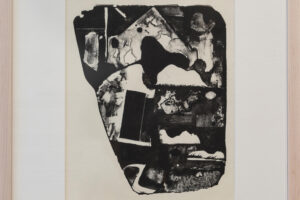 The MassArt Art Museum (MAAM) located inside the campus of the Massachusetts College of Art and Design at 621 Huntington Ave. in Boston brings together more than 35 original prints to honor the radical vision and enduring legacy of Robert Blackburn (1920–2003). He was a pioneering artist, educator, and master printer who founded in 1947, the Robert Blackburn Printmaking Workshop which is the longest-running community print shop in the United States. It became a vital, artist-centered space where artists of color and women could experiment freely at a time when they were excluded from mainstream institutions. It ultimately is celebrated for its spirit of collaboration and inclusiveness by its long service as a creative haven for artists of all backgrounds. It is noted for fostering technical innovation as well as aesthetic exploration in printmaking through works by artists that span multiple generations. Press & Pull traces the workshop’s outsized influence on American printmaking and its role as a national hub for artistic exchange, mentorship, and social change. The exhibition underscores Blackburn’s belief in printmaking as both a technical practice and a democratic tool for community-building. In 2002, Blackburn ensured the continuity of this legacy by relocating the workshop to the Elizabeth Foundation for the Arts (EFA) at 323 West 39th Street, New York, NY where it now operates as the Robert Blackburn Printmaking Workshop (RBPMW). Today, RBPMW continues Blackburn’s mission by providing an accessible and affordable studio environment that supports both traditional and contemporary printmaking techniques, and acts as a steward for the Robert Blackburn Print Collection. Spring 2026 programs extend both exhibitions beyond the gallery with a season of inclusive, hands-on, and inter-generational experiences. Visitors are invited to engage through artist talks, collaborative making, student-led gallery conversations, and festive evening events that center togetherness, storytelling, and creative exchange. MassArt ART MUSEUM (MAAM) is ALWAYS FREE! Open Friday – Sunday: (12pm – 5pm) and Thursday (12pm – 8pm)
NEW BEDFORD WHALING MUSEUM….For complete museum and exhibition details visit www.whalingmuseum .org
 The New Bedford Whaling Museum at 18 Johnny Cake Hill in the heart of the New Bedford’s historic downtown
ISABELLA STEWART GARDENER MUSEUM
See complete museum information under “MUSEUMS” www.gardnermuseum.org
>>>>>>>>>>>>>>>>>>>>>>>>>>>>>>>>>>>>>>
INSTITUTE OF CONTEMPORARY ART
www.icaboston.org See complete museum information under “MUSEUMS”
>>>>>>>>>>>>>>>>>>>>>>>>>>>>>>>>>>>>>>>>
GALLERIES
ONGOING: LANOUE FINE ART GALLERY
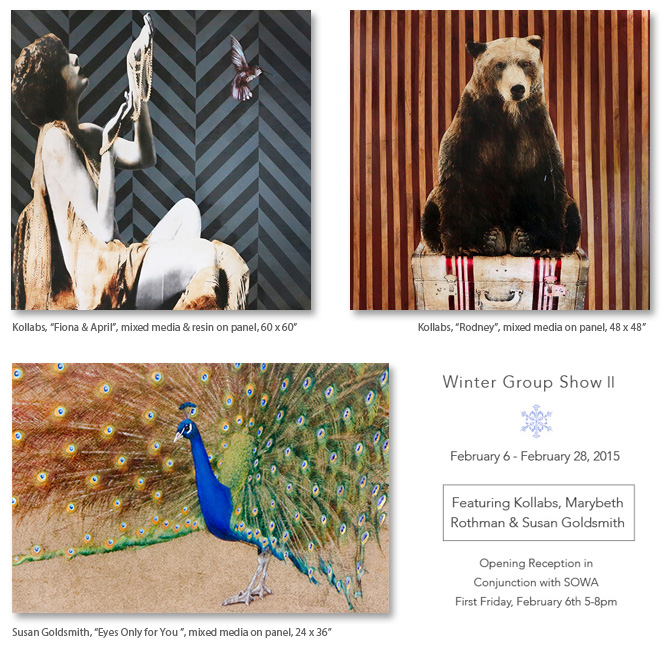 Located at 450 Harrison Ave. #31 in Boston (At Thayer Street, on the ground level), in the SOWA ART DISTRICT, this well established gallery hosts outstanding contemporary artists from around the world. For more information about current and up and coming artists go to www.LanoueGallery.com
ONGOING: MOVIMIENTO GALLERY
 Paul Walcott “Triple Entendre” Paul Walcott has established a new Gallery space in the dynamic SOWA art’s district at 450 Harrison Ave, 4th Floor, Suite #401, in Boston. He invites all to this new Gallery space in the dynamic SOWA art’s district in Boston! Each month, the Gallery features some of the most talented and innovative artists in New England as well as ongoing displays of art furniture. MOVIMIENTO is also the home of Tango Embrace, where they host a variety of tango events including workshops and private classes. For more information go to www.MOVIMIENTOspace.com.